Written, as with a sunbeam...
Pictured left to right: Lou Sandoval, Sue Scott, Gabrielle H. Lyon, José Ochoa, Dr. Ted Williams III

Features
Gabrielle H. Lyon
February 27, 2026
On February 23, 1775, nearly exactly 250 years ago as I write, Alexander Hamilton published "The Farmer Refuted, &c." His essay was part of an ongoing public pamphlet debate with Loyalist Samuel Seabury about the viability and merits of "universal rights."
Hamilton, a college student at the time, defended the concept with breathtaking eloquence, "The sacred rights of mankind are not to be rummaged for, among old parchments, or musty records... They are written, as with a sunbeam, in the whole volume of human nature, by the hand of the divinity itself..."
Robert Kagan, in Rebellion: Donald Trump and the Antiliberal Tradition in America, cites Hamilton's pamphlet as he traces the development of the argument used by colonists to declare independence. The Declaration of Independence grounds its authority to sever from Britain in (at the time new-ish) concept of Universal Rights: rights that exist irrespective of heritage, ancestry, nationality, culture or history.
These ideals were breathed into possibility. They weren't grounded on fact or evidence. At the time, they contradicted what many people believed at the time. As Kagan points out "... few ever acknowledge that others who are not like them-who are of different religions, tribes, and nations-also have an equal right to "recognition." [Kagan, p.33]
This fundamental contradiction - between the ethereal promise of an idea and lived reality - is a tension in our lives every day. Any of us can think of people we personally know who are not treated equally in the United States.
Imagination is what enables us to bridge this dyad.
I think about imagination a lot: my parents and siblings are artists, I'm most apt to read fiction, especially science and climate fiction. Central to my role at Illinois Humanities is helping our team imagine what is possible given our organization's vision and mission. I'm easily convinced imagination is not only important but also fundamental to our ability to be our most human selves.
But I was given a wholly new perspective on imagination in a recent Dispatch Faith essay by Hannah Anderson, "Lent Reminds Us that a Penitent Imagination Can Counter Evil," Anderson wrestles with how to make sense of her ongoing experience in which, "Someone posts a video on social media, and one person will see a virtuous display of patriotism while another will see the fall of democracy." Perhaps, she posits, what we're suffering from is less about politics and polarization and more about a lack of imagination.
And herein lies the twist:
"Imagination, then, may be one of the greatest forms of dissent in that it helps us see the possibilities of evil and unmask them. Imagination also allows us to enter into the plight of our neighbors who suffer under its brutality. And perhaps more than anything, imagination lets us conceive of a reality beyond the one we currently inhabit, showing us that things don’t have to be the way they are."
We need to do a better job at understanding that bad, evil, things really ARE happening to our neighbors, even though it causes us profound grief and dismay. Imagination is fundamental to how we arrive at that understanding.
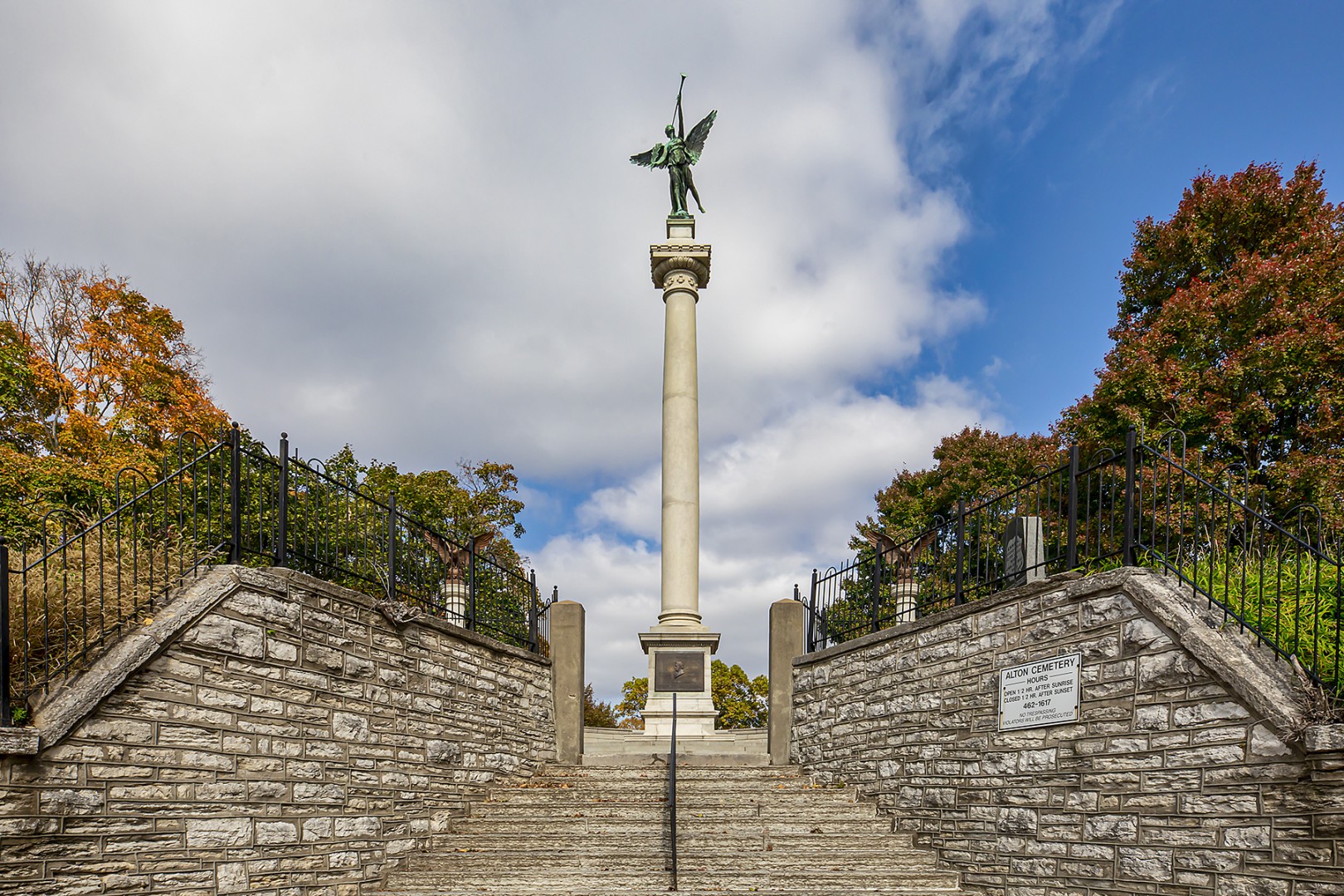
Illinois has always been a place of this kind of imagination, from Elijah P. Lovejoy, writer, publisher, abolitionist, free speech advocate and early martyr for the Civil War, whose monument stands in Alton Illinois, to our late civil rights champion, Reverend Jesse Jackson Sr, who was inspired by the Original Rainbow coalition and fought to forge unlikely alliances with activists across race and party lines, including, among others, the Young Patriots and Young Lords Organizations.

Photo courtesy of Convergence Magazine.

Photo courtesy of River & Routes Tourism Bureau
Imagination needs a spark. Illinois Humanities' programs at their best, make it as likely as possible people have a chance to imagine: our Road Scholars' presentations, announced just February 3, 2026 are especially designed to pique our curiosity, surprise our intellects, and offer the potential to fuel inquiry and conversation about ideas and works that shape us and the ways we live together.
For Anderson, imagination help leads us along the path to the Kingdom of Heaven. As an atheist this last part isn't that resonant for me personally. For me what is most resonant is her advocacy that we dig in deep - even when it's hard - to stretch beyond the comfortable and familiar and practice the art of imagination. Imagination is what Hamilton advocated for. Imagination is what will enable us to continue to find the path forward to securing equal rights for everyone in our country.
And that bridge might just be, at most, a sunbeam away.

Illinois Road Scholar Speaker, Dennis Stroughmatt, performing in Shaweneetown in 2025.

Road Scholar Speaker, Ada Cheng ph.d, giving a presentation at The Urbana Free Library
Contact
Suite 650, 125 South Clark St.
Chicago, IL 60603
312.422.5580 312.374.6787 Fax
Illinois Humanities is supported in part by the National Endowment for the Humanities (NEH) and the Illinois General Assembly [through the Illinois Arts Council], as well as by contributions from individuals, foundations, and corporations.


Illinois Humanities respects the privacy of its audiences and will at no time sell or distribute personal information to any party not directly affiliated with Illinois Humanities and its programs.
Any views, findings, conclusions, or recommendations expressed by speakers, program participants, or audiences do not necessarily reflect those of the NEH, Illinois Humanities, our partnering organizations, or our funders.
© Copyright 2026 Illinois Humanities